
Keyword Research for Unrivaled SEO Performance

The foundational element of any successful SEO strategy is systematic keyword research. It’s the process of discovering the precise language your customers use to find your products, services, and solutions. Without this critical first step, even the most significant marketing investment is based on guesswork, not data.
You need more than traffic; you need the right traffic. You need visitors with intent – potential customers actively searching for what you offer. Most SEO efforts fail not because of a lack of effort, but because they target the wrong audience with the wrong message.
This page provides complete clarity on the process of SEO keyword research. From initial discovery to final implementation, you will understand how to build an SEO foundation that drives predictable, scalable growth.
Keyword Research: The Foundation of Measurable SEO Success
Keyword research is the systematic process of identifying, analyzing, and selecting the search terms that people enter into search engines. It’s not just about finding high-volume phrases; it’s about understanding market demand and, most importantly, user intent. For any business aiming for sustainable online growth, this process is non-negotiable. It provides the data-driven framework for nearly every other SEO activity.
A structured approach to keyword research delivers critical business intelligence across several fronts:
- Uncover Audience Intent: Keywords are a direct reflection of your audience’s needs, questions, and pain points. Analyzing these terms reveals precisely what potential customers are looking for. This insight allows you to move beyond assumptions and connect with users based on their expressed needs, whether they are looking for information, comparing options, or ready to make a purchase.
- Identify Market Opportunities: Thorough website keyword research exposes untapped niches and competitive gaps. By analyzing the terms your competitors rank for (and the ones they miss) you can identify valuable opportunities to capture market share. This process uncovers “low-hanging fruit” keywords that can deliver targeted traffic more quickly and efficiently.
- Drive Relevant Traffic: The ultimate goal of SEO is not just to increase visitor numbers but to attract visitors who are likely to convert. Targeting the right keywords ensures that the traffic arriving at your site is highly relevant to your offerings. This direct alignment between search intent and landing page content leads to higher engagement, lower bounce rates, and a greater return on investment.
- Inform Content Strategy: Keywords provide the thematic foundation for your entire content plan. Instead of guessing what topics will resonate with your audience, SEO keywords research provides a clear roadmap. Each keyword represents a topic that your audience cares about, guiding the creation of valuable, rank-worthy content that directly addresses their queries and establishes your topical authority.
However, every decision must be grounded in real SERP data (Google’s results page), not assumptions.
Beyond Volume: The Strategic Pillars of Keyword Selection
Most superficial SEO efforts stop at search volume. We deliver a more sophisticated analysis. Effective keyword selection for a robust semantic core requires a systematic evaluation of multiple factors to ensure your strategy is not only ambitious but also achievable and profitable. This means building a balanced portfolio of terms that align with your business goals and competitive reality.
Our process is built on four critical pillars for strategic keyword selection:
- Keyword Relevancy: A keyword is only valuable if it directly aligns with your business objectives. True relevancy means the user’s search intent matches the solution you provide on your landing page. We analyze the “why” behind a search to ensure that when a user clicks through, they find exactly what they were looking for, leading to a seamless user experience and higher conversion potential.
- Search Volume: This metric indicates the demand for a particular keyword, typically measured in average monthly searches. While high-volume keywords are attractive, they often come with intense competition. A strategic approach involves balancing these “head” terms with more specific, lower-volume long-tail keywords that often have higher conversion rates. Understanding search demand allows for realistic traffic projections and resource allocation.
- Keyword Difficulty (KD): Keyword difficulty is a metric that estimates how hard it will be to rank on the first page of Google for a given term. It’s a crucial factor for managing expectations and resources. Targeting exclusively high-KD keywords without the requisite domain authority or backlink profile is a recipe for wasted effort. A smart strategy prioritizes keywords with a manageable difficulty score to build momentum.
- Weak Spots in SERP: We go beyond metrics to perform a manual analysis of the Search Engine Results Page (SERP). This involves looking for competitive weaknesses. Are the top-ranking pages low-quality? Do they fail to fully address user intent? Are there forums or outdated articles on page one? Identifying these weak spots reveals opportunities where superior content can rank more quickly than KD scores might suggest.
By systematically evaluating these four factors, we build a robust keyword portfolio engineered for both short-term wins and long-term market dominance.
Decoding Keyword Difficulty: Your Competitive Edge
Keyword difficulty (KD) is one of the most critical metrics for strategic planning, acting as a proxy for the level of effort, resources, and time required to achieve first-page rankings. It is typically scored on a scale of 0-100, with higher scores indicating greater competition. Understanding KD allows a business to create a realistic and effective SEO roadmap.
High KD keywords (often 70+) are usually targeted by established brands with high domain authority and extensive backlink profiles. Pursuing these terms requires a significant, long-term commitment involving comprehensive content creation, aggressive link-building campaigns, and technical SEO excellence. For new or smaller websites, targeting these keywords from the outset is an inefficient use of resources.
The strategic advantage often lies in targeting low-to-medium KD keywords. These terms may have lower search volume, but they offer a much more accessible path to page one. Securing rankings for these keywords allows a website to generate relevant traffic and build domain authority more quickly. These early wins create a foundation of credibility and link equity that can be leveraged later to target more competitive terms.
KD directly influences content strategy. For example, a high-difficulty keyword might necessitate a 3,000-word cornerstone content piece supported by a cluster of related articles. A medium-difficulty keyword might be effectively targeted with a specific, in-depth blog post. A balanced approach that blends different KD levels ensures a steady stream of results while simultaneously building towards more ambitious, long-term goals.
DIY vs. Agency: The True Cost of Keyword Research
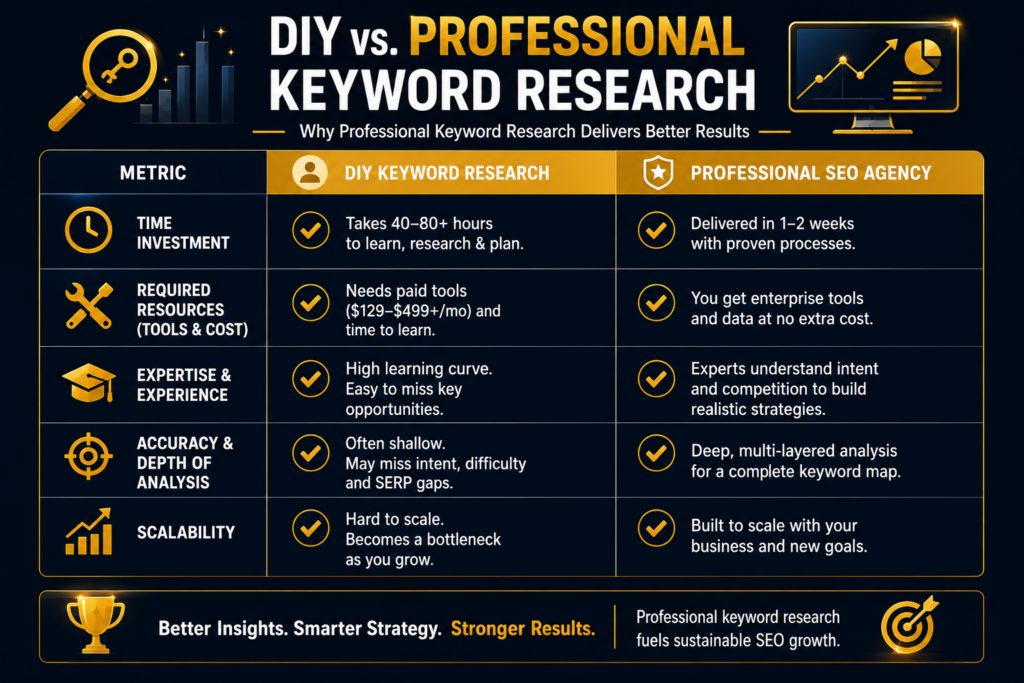
Embarking on SEO keyword research presents a critical decision for any business: handle it in-house or partner with a specialized agency. While the DIY approach may seem cost-effective on the surface, it often carries hidden costs in the form of time, tool subscriptions, and the potential for strategic errors due to inexperience. An agency provides access to established processes, enterprise-level tools, and specialized expertise, delivering predictable and efficient results.
The question is not simply about cost, but about value, efficiency, and scalability. Most businesses that attempt DIY keyword analysis underestimate the significant learning curve and time investment required for a comprehensive study. An agency plugs into your workflow, handling the complexities of data analysis so you can focus on your core business operations.
Here is a direct comparison of the two approaches:
| Metric | DIY Keyword Research | Professional SEO Agency |
|---|---|---|
| Time Investment | Significant. A project for a small to medium website can take 40-80 hours, including learning the tools, data collection, analysis, and strategy formulation. This does not account for ongoing monitoring. | Efficient. Agencies leverage established, repeatable processes and experienced analysts to deliver a complete strategy, often within 1-2 weeks. |
| Required Resources (Tools & Cost) | Requires subscriptions to multiple tools. Costs for leading platforms like Ahrefs or Semrush range from $129 to $499 per month for standard plans. Effective use requires training and experience. | No direct cost to the client. Agencies provide access to a suite of enterprise-level tools and proprietary databases as part of their service, representing thousands of dollars in annual value. |
| Expertise & Experience | High learning curve. Beginners risk misinterpreting data, targeting competitive keywords, or missing long-tail opportunities. This can lead to a flawed strategy and wasted content creation efforts. | Specialized knowledge. Agency experts understand the nuances of search intent and competitive landscapes. They ensure the final strategy is actionable, realistic, and aligned with business goals. |
| Accuracy & Depth of Analysis | Often superficial. Without experience, it’s easy to focus solely on search volume while neglecting keyword difficulty, user intent, and SERP weaknesses. This leads to an incomplete and often ineffective strategy. | Systematic and comprehensive. Agencies perform multi-layered analysis, including competitor backlink profiles, content gap analysis, and intent modeling to build a robust and data-driven keyword map. |
| Scalability | Limited. As a business grows, enters new markets, or expands its product lines, the time and complexity of DIY research increase exponentially, becoming a significant operational bottleneck. | Built to scale. Agencies can easily adapt and expand research efforts to match business growth, evolving market dynamics, and new strategic initiatives without disrupting the client’s internal resources. |
Essential Resources for Effective Keyword Discovery
For businesses considering the DIY path for keyword research, it’s crucial to understand the required resources. The process is more than just brainstorming ideas; it demands a structured approach supported by the right tools and a significant time commitment. While it is possible for a novice to conduct basic keyword research, the depth and strategic accuracy will be limited without experience and access to professional-grade data.
A beginner can certainly identify relevant topics and generate a list of potential keywords using free tools. However, the critical steps of accurately assessing keyword difficulty, analyzing the competitive landscape, and mapping keywords to the buyer’s journey require a more sophisticated skill set. The primary risk for a newbie is developing a strategy based on incomplete or misinterpreted data, leading to content that fails to rank and delivers a poor return on investment.
Navigating the Tool Landscape: Free, Paid, and Professional
The right keyword research tool depends on your budget and the required depth of analysis. The market offers a wide range of options, from free entry-level tools to sophisticated paid platforms.
- Free Keyword Analysis Tools:
- Google Keyword Planner: A good starting point for generating keyword ideas and getting search volume estimates directly from Google. However, its volume data is often presented in broad ranges for non-advertisers, limiting its precision.
- Google Search Console: An essential tool that shows you the keywords your website *already* ranks for. It’s invaluable for identifying “striking distance” keywords (ranking on page 2) that could be pushed to page 1 with optimization.
- AnswerThePublic / Ubersuggest (Free Tiers): These tools are excellent for brainstorming and understanding user intent. They visualize the questions, prepositions, and comparisons people use in their searches around a core topic. The free versions have daily search limits.
- Paid Keyword Research Tools:
- Ahrefs, Semrush, Moz Keyword Explorer: These are the industry-standard, all-in-one SEO platforms. They provide more accurate keyword difficulty scores, in-depth competitor analysis, backlink data, and extensive keyword suggestion features.
- These tools offer advanced functionalities that are crucial for a comprehensive analysis. Subscription costs for their standard, most popular plans typically range from approximately $129 to $250 per month.
- Professional-Grade Tools: Agencies often invest in enterprise-level subscriptions or use a combination of specialized, integrated platforms that provide more granular data, historical trend analysis, and API access for customized reporting. This level of tooling is generally beyond the budget and needs of most individual businesses.
While free tools are useful for initial exploration, a serious keyword strategy relies on the more accurate and comprehensive data provided by paid platforms.
Time & Effort: The Real Investment in Keyword Strategy
Thorough keyword research is a multi-step and time-consuming process. Underestimating the investment required often leads to shortcuts that compromise the quality of the final strategy. A structured project requires dedicated focus across several distinct stages.
Here is a realistic breakdown of the time commitment for a comprehensive SEO keyword analysis for a small-to-medium-sized website:
- Initial Brainstorming & Seed Keywords (2-4 hours): This involves identifying the core topics relevant to your business and compiling an initial list of “seed” keywords to feed into research tools.
- Tool Exploration & Data Collection (8-16 hours): This is the most labor-intensive phase. It involves using tools like Ahrefs or Semrush to expand your seed list into thousands of potential keywords, gathering metrics like volume, KD, and CPC for each one.
- Filtering & Analysis (10-20 hours): This critical stage involves sifting through the raw data to remove irrelevant terms, grouping keywords by user intent (informational, commercial, transactional), and performing a detailed SERP analysis for the most promising candidates. For a comprehensive project, this can take several days.
- Organization & Prioritization (4-8 hours): Once analyzed, the selected keywords must be organized into a logical structure. This often involves creating a keyword map that assigns primary and secondary keywords to specific pages on your website, creating a clear plan for implementation.
- Ongoing Monitoring & Refinement: Keyword research is not a one-time task. It is an iterative process. You must budget several hours each quarter to monitor rankings, identify new opportunities, and refine your strategy based on performance data and market shifts.
Attempting to rush this process inevitably leads to a flawed strategy built on incomplete data, ultimately wasting the time and resources invested in content creation.
From Data to Dominance: Implementing Your Keyword Strategy
A well-researched keyword list is only potential energy. The transition from raw data to market dominance requires a systematic implementation plan. This process turns your keywords research into a performance-driven content and optimization strategy that captures qualified traffic and drives business growth. Every recommendation is grounded in a structured workflow, not improvisation.
The implementation is executed across five distinct phases:
- Phase 1: Content Mapping & Planning:
- The first step is to create a keyword map, a blueprint that assigns a primary target keyword and a group of secondary, related keywords to each important page on your website.
- This map informs your content calendar, ensuring that every new blog post, landing page, or product description is created with a clear search intent and keyword purpose.
- This prevents keyword cannibalization and ensures your site architecture is logical and authoritative.
- Phase 2: On-Page Optimization:
- Keywords must be integrated naturally into critical on-page elements. This includes the page title tag, meta description, H1 heading, and subheadings (H2, H3).
- The primary keyword and its variations (LSI keywords) should be used within the body content in a way that is readable and provides value to the user, not just stuffed for search engines.
- Image optimization is also key, with keywords incorporated into alt text and file names to provide additional context to search crawlers.
- Phase 3: Technical Integration:
- Your website’s technical foundation must support your keyword goals. This includes creating clean, descriptive URL structures that, where appropriate, include the primary keyword.
- Implementing structured data (schema markup) can help search engines better understand your content and can lead to enhanced SERP visibility through rich snippets.
- Technical factors like mobile-friendliness and fast page load speeds are crucial, as they directly impact user experience and can indirectly affect keyword rankings.
- Phase 4: Off-Page & Promotion:
- The authority of a page is a major ranking factor. A key part of implementation is building high-quality backlinks from reputable websites to the pages you want to rank for your target keywords.
- Content promotion across relevant channels (social media, email newsletters, industry forums) increases visibility, drives initial traffic, and can attract natural backlinks.
- Phase 5: Monitoring & Iteration:
- Implementation is not a “set it and forget it” task. We use analytics tools to track keyword rankings, organic traffic, click-through rates, and conversion metrics for your target pages.
- This performance data is analyzed to identify what’s working and what isn’t. Underperforming keywords may need a content refresh, while new opportunities may emerge from your performance data.
- The strategy is regularly refined based on this feedback loop, ensuring continuous improvement and adaptation to evolving search trends.
Consistent, structured implementation is what transforms a keyword research document into measurable SEO results.
FAQ:
Elevate Your SEO: Partner with Our Keyword Research Experts
Stop guessing. Start dominating. It’s time to move from arbitrary content creation to a systematic, data-driven strategy. Our professional keyword research services are designed to uncover the high-value opportunities your competitors are missing and align your business with the language of your ideal customers.
Our unique approach ensures no opportunity is overlooked:
- Data-Driven Methodology: Our systematic process combines proven methodology with modern, enterprise-grade tooling. Every recommendation is grounded in real SERP data, search volume analysis, and user intent modeling, not assumptions.
- Competitive Intelligence: We don’t just analyze your website; we deconstruct your rivals’ strategies. We identify the keywords that drive their traffic, uncover their content weaknesses, and map out a clear path for you to gain a competitive advantage.
- Tailored Strategies: We deliver custom keyword plans designed specifically for your business goals, budget, and competitive landscape. No generic reports or one-size-fits-all solutions. Just a clear, actionable roadmap for growth.
- Ongoing Support: Our partnership doesn’t end with a data file. We provide the strategic guidance needed to implement your keyword map, monitor performance, and adapt your strategy as your business and the market evolve.
Navigating the complexities of a keyword check and research often brings up critical questions for businesses. A robust keyword strategy involves proactive problem-solving and a clear understanding of advanced concepts.
Take the first step toward predictable, scalable organic growth.